Executive Summary
The broadcast industry's shift toward file-based environments requires more than just new
hardware; it demands a total integration of content and metadata. This project involved
engineering and deploying a new ingest and editing facility at the PBS Media Operations Center.
By replacing traditional hardware signal paths with an intricate choreography of middleware, XML
messaging, and automated "flattening" processes, PBS successfully eliminated redundant data
entry and manual re-editing, paving the way for a fully automated program reassembly future.
The Challenge
For decades, broadcast environments relied on manual, tape-based workflows where metadata
was often disconnected from the video "essence." PBS faced several critical inefficiencies:
Data Fragmentation: Metadata lived in scheduling systems while video lived on tapes,
leading to manual re-entry and high error rates.
Resource Intensity: Program re-packaging (e.g., changing underwriters or promos)
required hours of manual labor in editing suites.
Format Rigidity: Content needed to be available in multiple formats (High-Res for
editing, Mid-Res for air, Low-Res for proxy) without creating a
bottleneck in manual transcoding.
The Solution: An Integrated Ecosystem
We designed a "seamless" architecture that bridges the gap between the BroadView scheduling
system and the Avid post-production environment using Microsoft BizTalk as the integration layer.
1. Automated Metadata Ingest
The process begins with the producer submitting "Media Inventory" via a web portal.
· The "One-Click" Catalyst: Scanning a bar-coded label upon tape arrival triggers a chain reaction:
BroadView updates status to "Arrived," generates an AAF file for Avid Unity, and sends an XML
message via BizTalk to ScheduALL to create a technical work order.
· Frame-Accurate Locators: Technicians use Avid Adrenaline to verify "in" and "out" points for
every segment. These locators are stored as metadata, allowing for future automated "stitching"
of program elements.
2. Multi-Tiered Archiving Strategy
To balance performance and cost, we implemented a four-tier automated archiving system
using MassTech and ADIC tape libraries:
· Production Tier (IMX50 MXF): High-bitrate files for lossless re-editing.
· Broadcast Tier (50 Mbps MXF): Optimized for playout on Omneon servers.
· Distribution Tier (8 Mbps MPEG): The "Flattened" file for satellite and broadband delivery.
· Proxy Tier (1.5 Mbps Windows Media): Low-res copies for desktop screening and
annotation.
3. Software-Defined Re-Packaging
By utilizing frame-accurate metadata, PBS can now replace underwriters or promotional spots
strictly via software. The system "re-packages" the program by following timing instructions in
the metadata, eliminating the need for a physical edit session.
Technical Environment
Category
Systems / Protocols
Orchestration
Microsoft BizTalk (XML messaging), BroadView, ScheduALL
Content Creation
Avid Media Composer, Avid Unity, Avid Transfer Manager, Photoshop, Illustrator, After Effects
Quality Control
VideoTek VTM 440, Dolby LM100 (Loudness Metering)
Storage & Archive
MassTech MassStore, ADIC Scalar 10K (LTO), Omneon Servers
Protocols
MXF (OP 1a), Avid API, FTP, UDP Multicast, SOAP/XML
The Results
· Operational Efficiency: Automated "stitching" of programs saved hundreds of man-hours
previously spent on manual re-ingestion and editing.
· Data Integrity: The "single source of truth" for metadata significantly reduced on-air \
discrepancies caused by manual data entry.
· High-Speed Transfers: FTP-based transfers between Avid and MassTech achieved
speeds 3x faster than real-time, exceeding initial expectations.
· Improved Technical Quality: By eliminating unnecessary codec cycles through a unified
file-based path, the end-to-end signal quality delivered to member stations was
measurably improved.
Key Takeaway: This project proved that the "Intricate Choreography" of IT disciplines—database optimization, IP networking, and message-passing protocols—is the new backbone of modern broadcast engineering.
Case Studies & Strategic Impact
Deep Dive
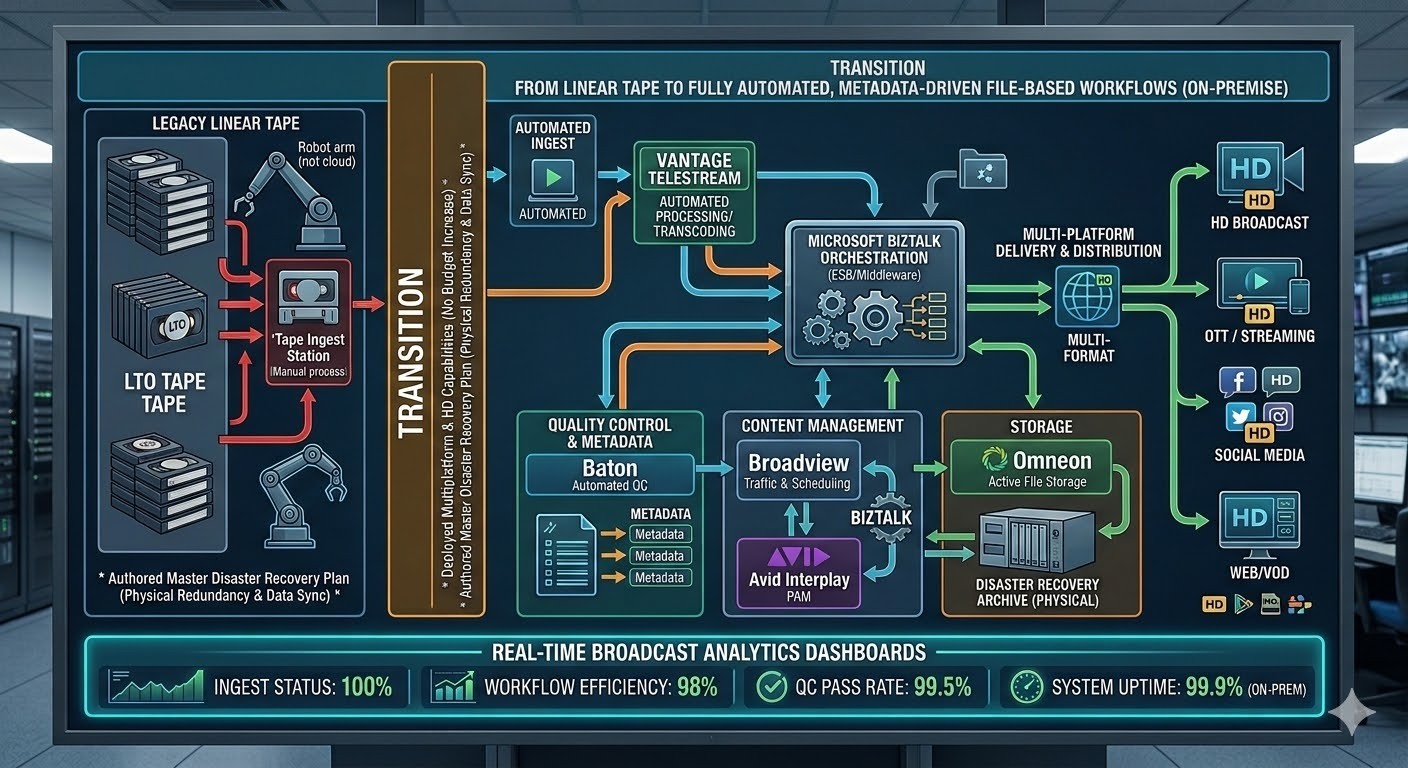
Transforming PBS Media Operations from Linear Tape to an Integrated, Metadata-Driven File Workflow with Automated Ingest and QC, allowing to triple the distribution.
Published: Contributed the Digital Asset Management chapter to the NAB Engineering Handbook (11th Edition)
The industry standard for broadcast engineering.